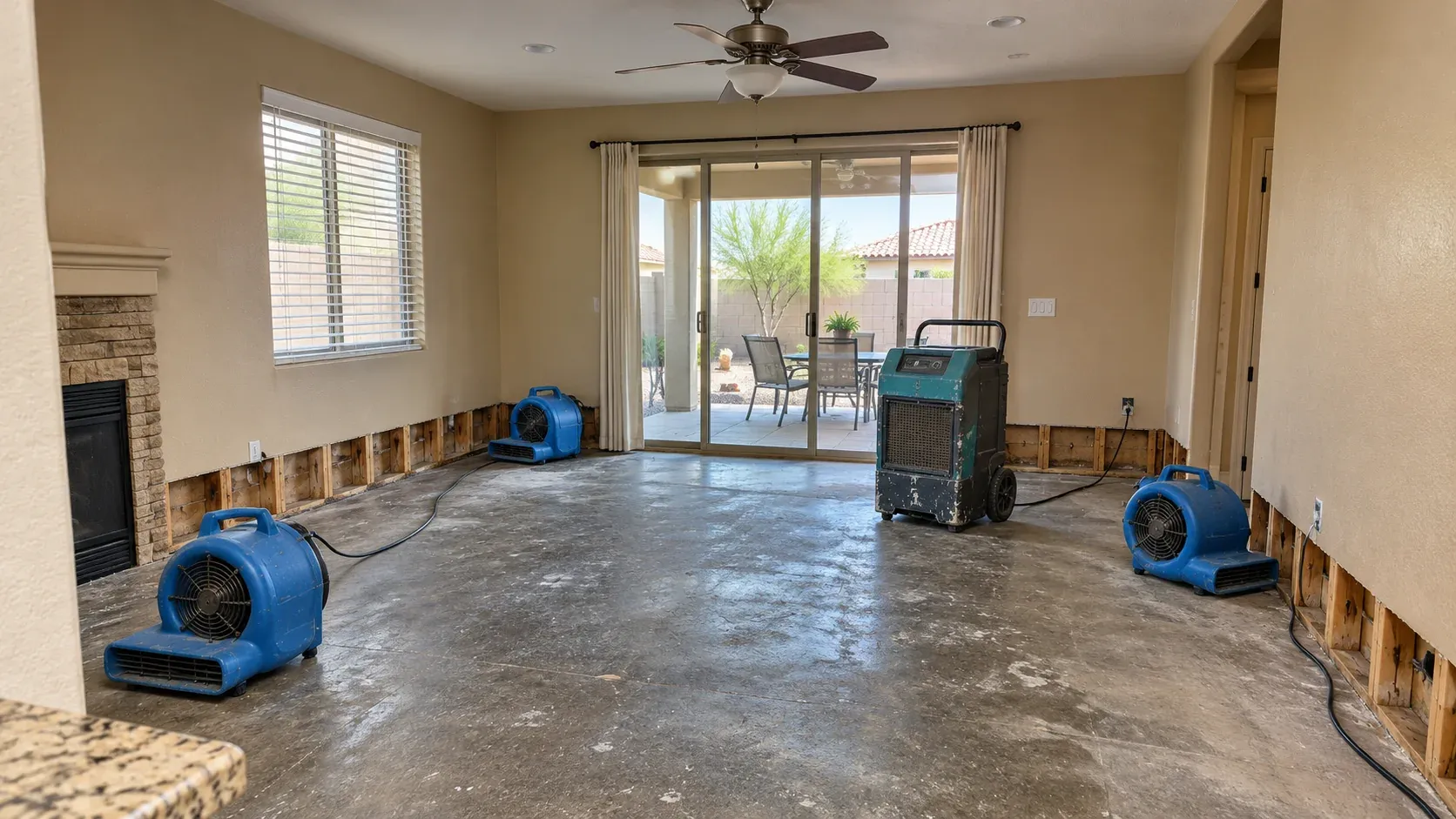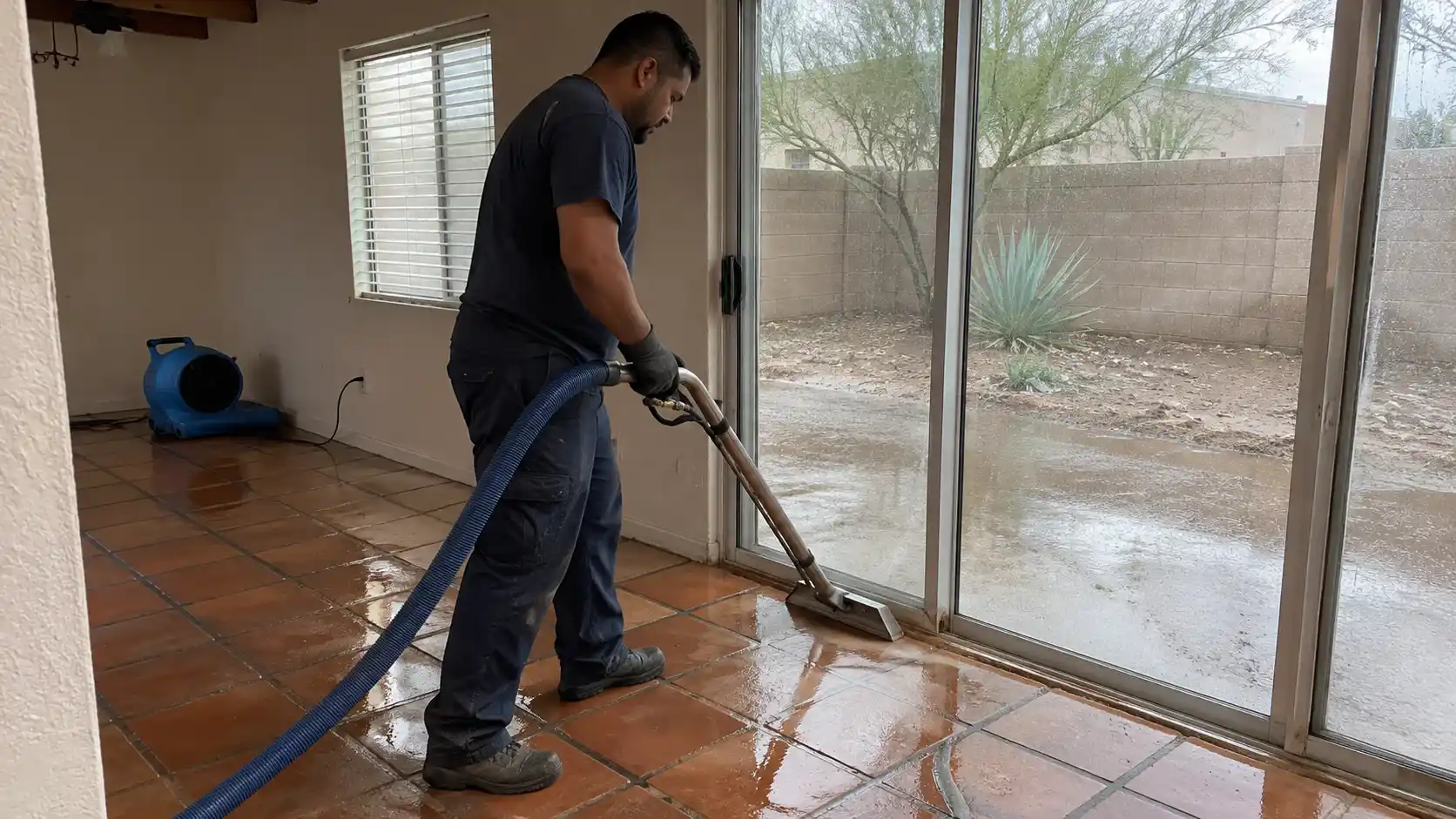
Service 01 of 06 · Tempe, AZ
Water Extraction in Tempe, AZ
You have standing water in the house, and it spreads further every hour. Call day or night or send the form, and someone from our team will call you back soon. Pumping out and drying follow.
Line open now
Get a call back
Tempe · Mesa · Chandler · Gilbert · Ahwatukee · Guadalupe + 13 more towns
01What you get
Standing water out before it spreads
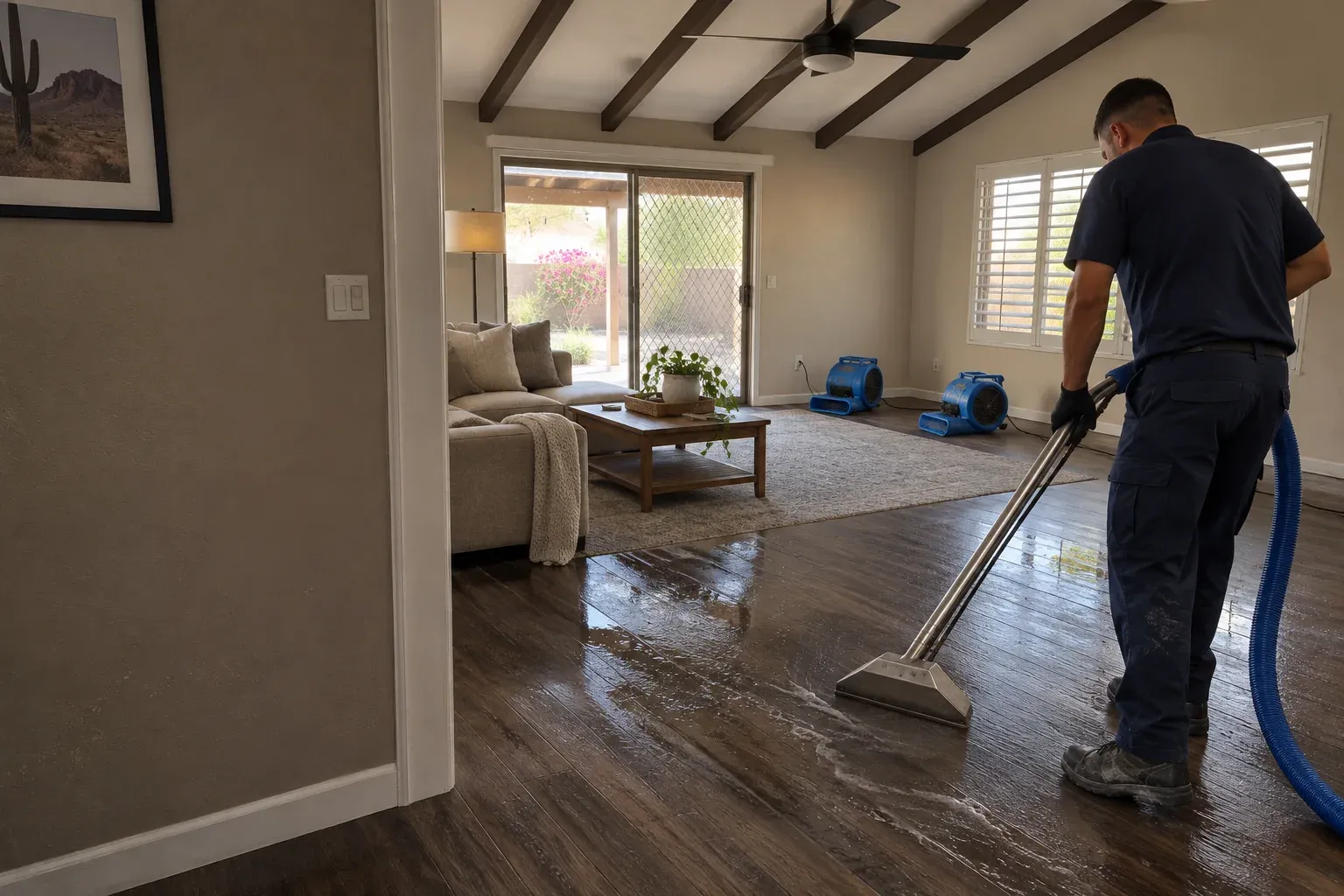
Standing water out of carpet, tile and low spots, with the source found before the drying equipment goes down.
- Standing water pulled out of carpet, pad, tile grout and low spots.
- The source found first, so the room does not fill again.
- Moisture readings at the edge of the wet area before anyone calls it done.
- Drying set up right after, with readings until the material is dry.
02The signs
5 signs you need water extraction in Tempe
Any one of these is reason enough to call.
- 01Water is standing on the floor. Carpet wicks it sideways into the next room.
- 02The carpet squishes or the pad is soaked. Pad holds water against the tack strip and the drywall.
- 03Grout lines look dark after a leak. Grout is permeable, so water gets under the tile and sits on the slab.
- 04Storm water came in at a patio door or the garage. Water from outside is treated as contaminated.
- 05A baseboard is starting to swell. The water has already reached the wall.
03How it works
What happens after you call
Your call starts a fixed sequence.
- 1Call or send the form, day or night.Say where the water is, whether it is still running and how long it has been there.
- 2Someone from our team calls you back.We go over what is wet and what has to happen first.
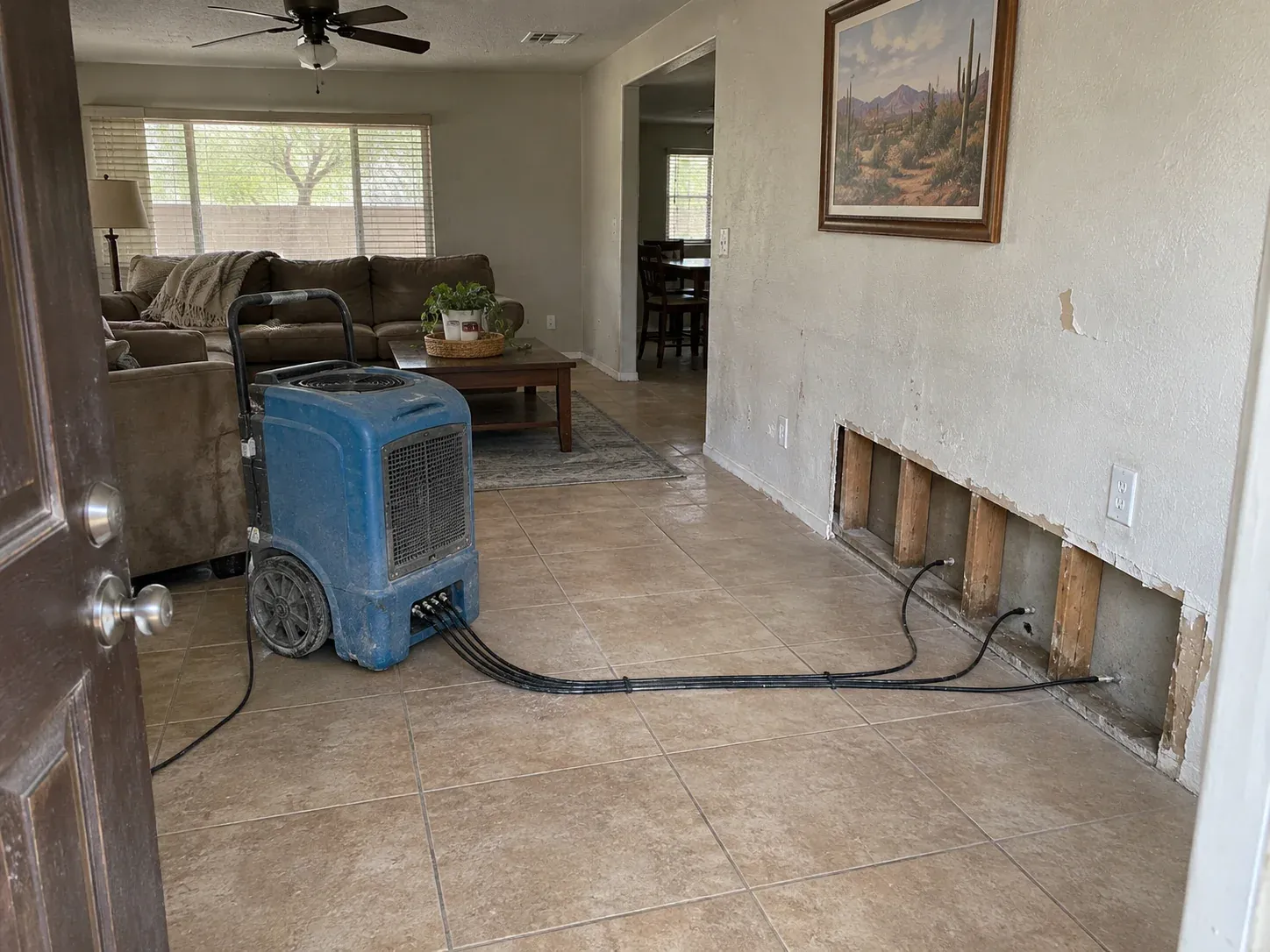
- 3Pumping out and drying follow.Standing water first, then air movers and dehumidifiers, with readings until the material is dry.
Service sheet
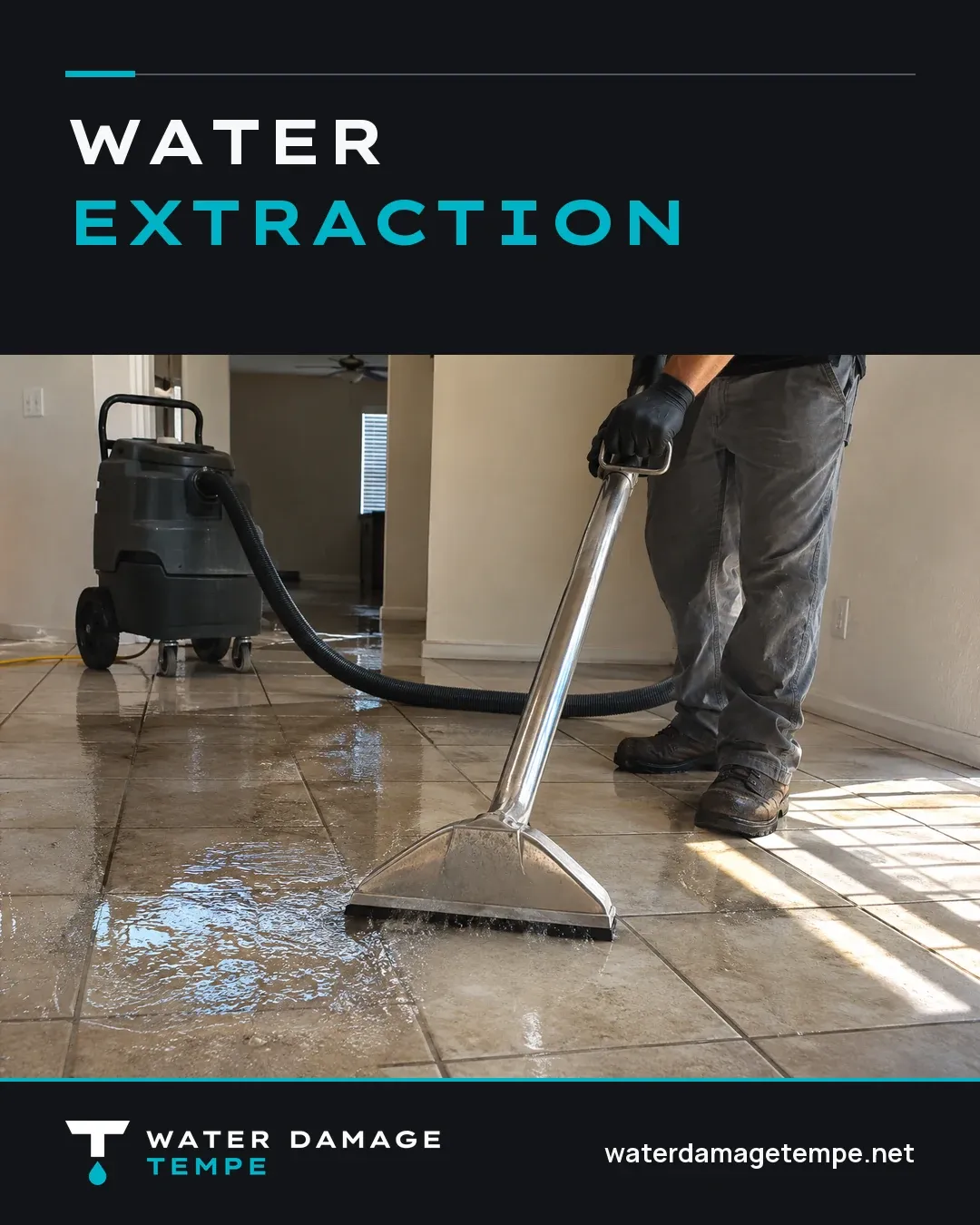
Water Extraction in Tempe
Standing water out of carpet, tile and low spots, with the source found before the drying equipment goes down.
04Costs
What extraction costs
Published national rates, by the category of water. Your category is set by what the water touched, not by how deep it is.
| Water category | Per sq ft | Typical source |
|---|---|---|
| Category 1, clean | $3.75 to $4.25 | Supply line, water heater, AC condensate, overflowing sink |
| Category 2, gray | $4.10 to $6.50 | Washing machine discharge, dishwasher, toilet overflow without solids |
| Category 3, black | $7 to $7.50 | Sewage backup, storm water that came in from outside |
Source: Fixr, 2025. National extraction rates, per square foot of affected area, before drying, build-back or repairs.
Fixr puts full water damage restoration at $1,200 to $5,000, with a national average of $3,000. Extraction is one line item inside that number.
05Good to know
Water on the floor is a clock, not a mess
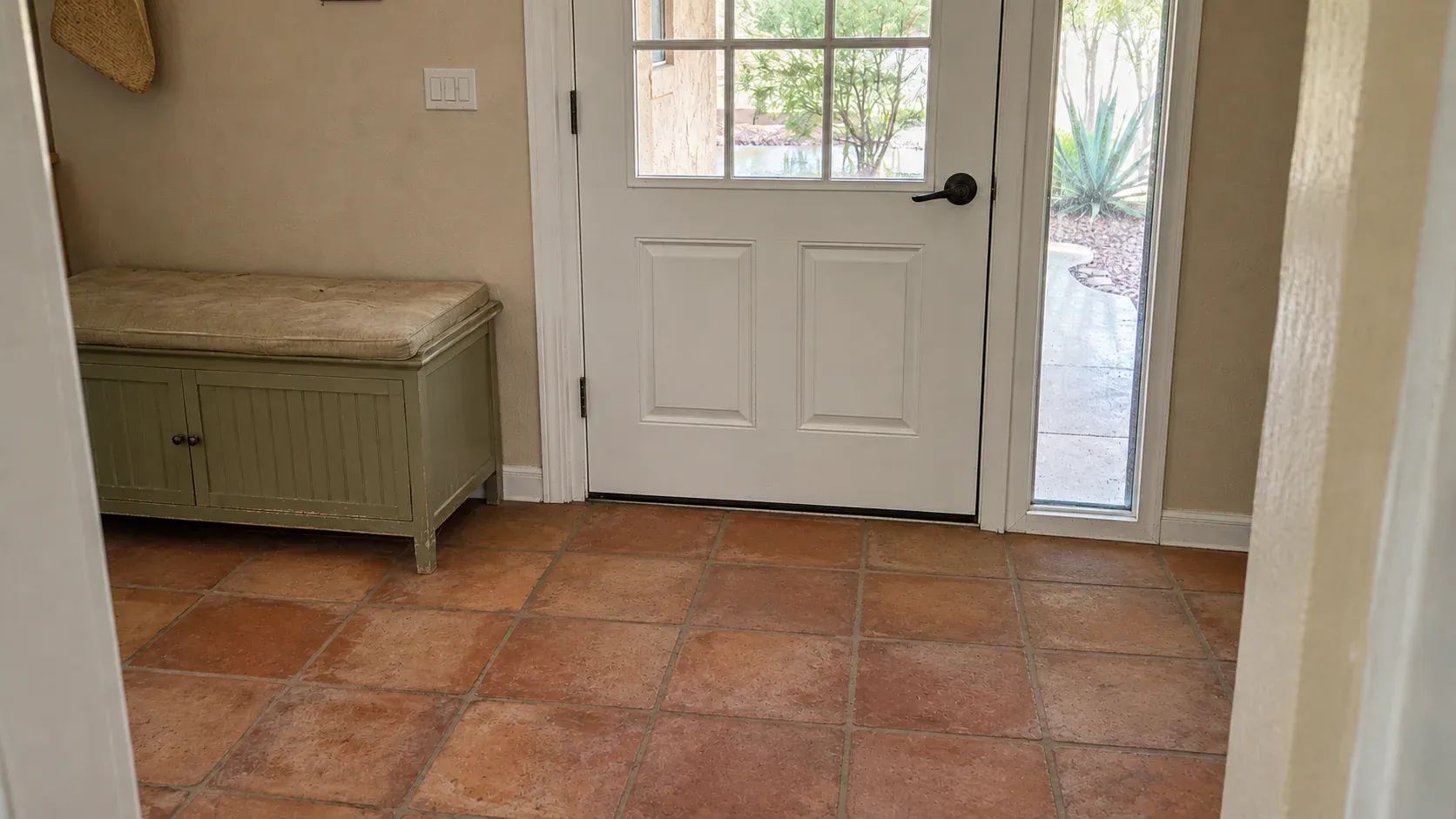
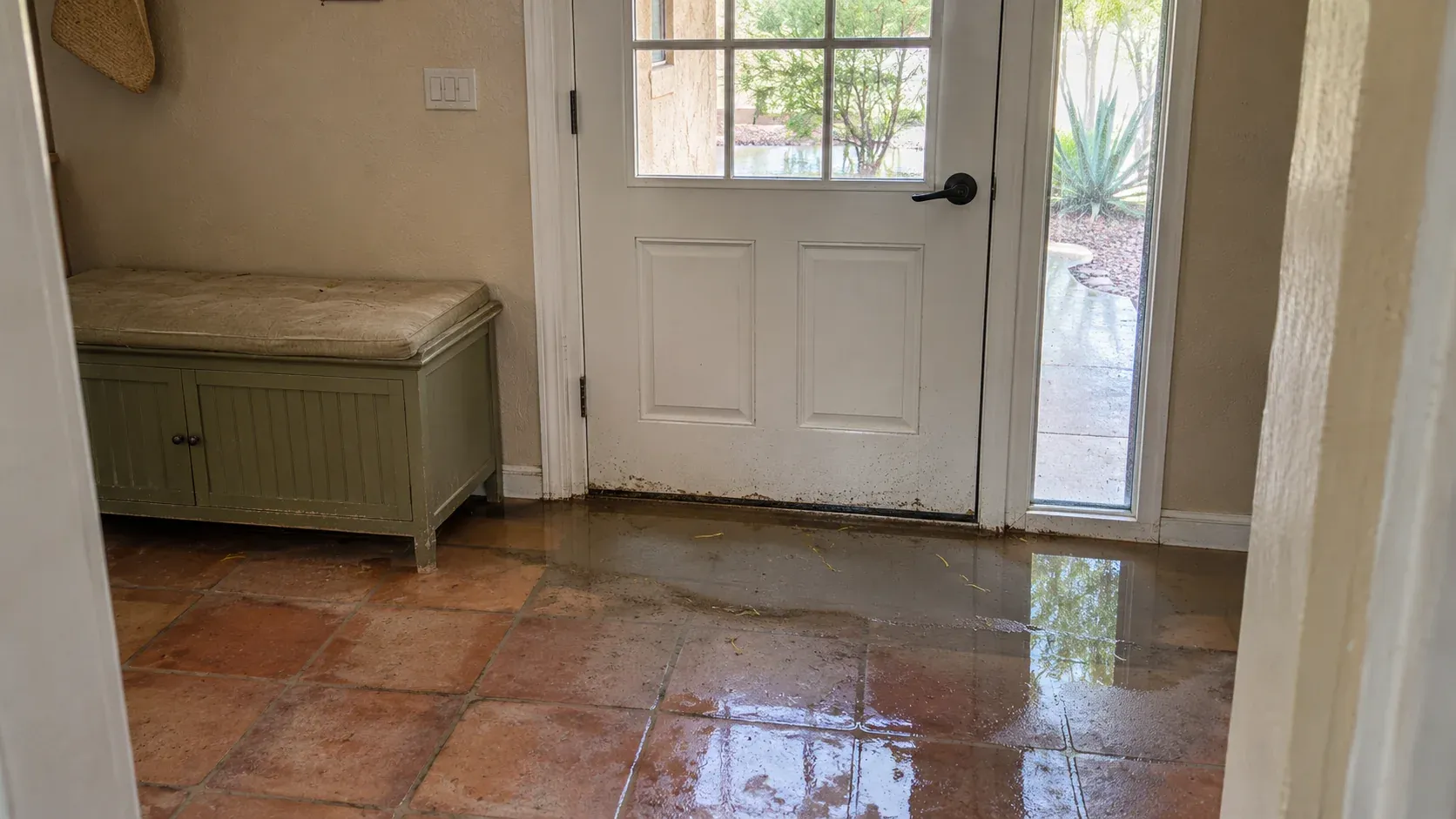
The longer water sits in a Tempe home, the further it can travel. Carpet wicks it sideways into the next room. Pad holds it against the tack strip and the drywall. Tile grout lines channel it under the field tile, where it sits on the slab with nowhere to evaporate. Within a couple of days the baseboard can swell and the smell can start.
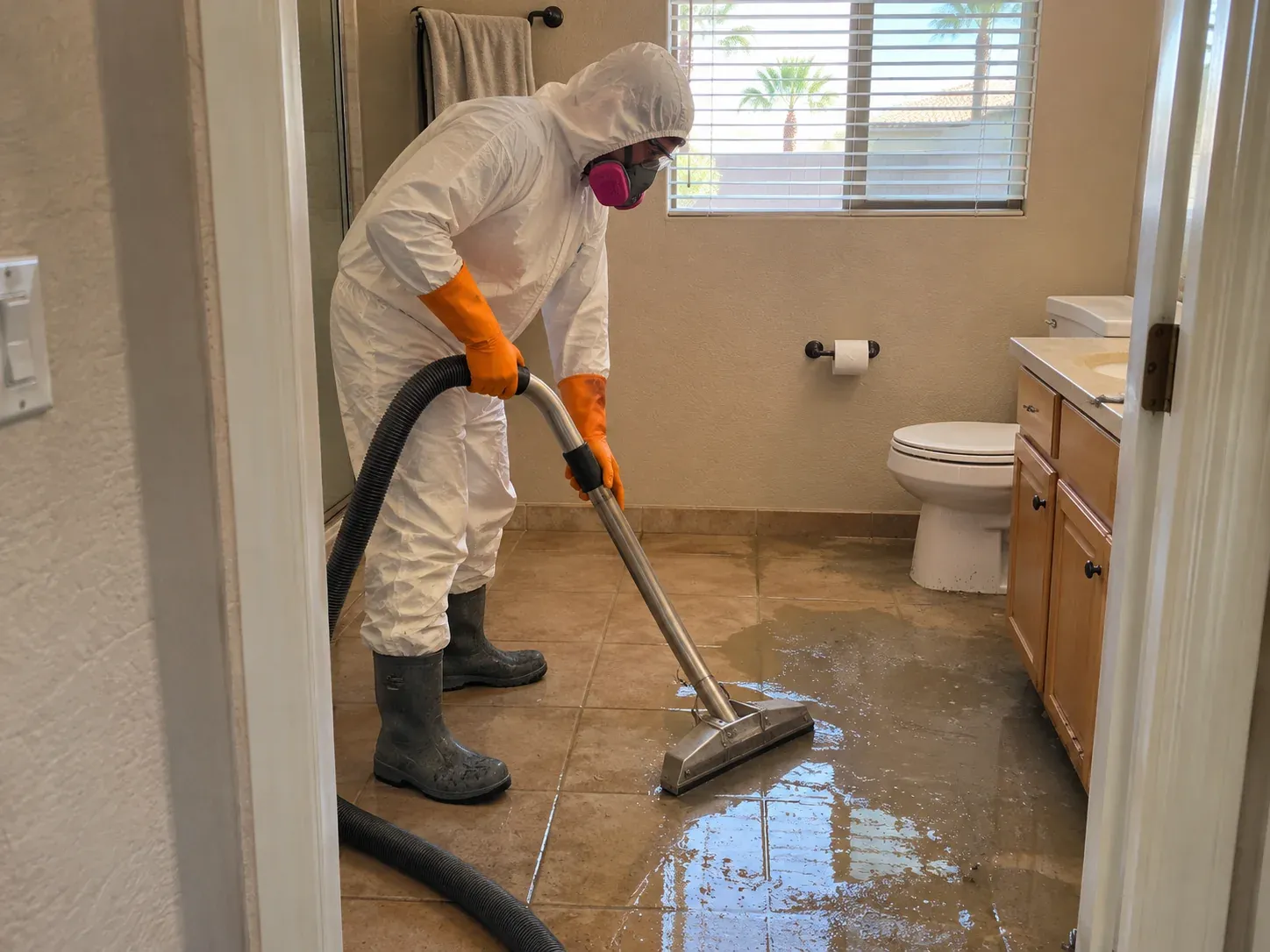
Extraction is the part that stops the clock. Commercial extraction equipment pulls water out of carpet and pad in a fraction of the time a wet vac takes, and the faster the bulk water is gone, the fewer days the drying equipment has to run.
The source gets identified before the room is extracted, because pumping water out of a room with a live supply line leak in the wall is a bill that repeats.
063 steps
Before the extraction starts
3 things that make the extraction easier and the bill smaller.
Water off, breaker off
Main valve, and the breaker for any room with water on the floor, if you can reach the panel without standing in water.
Lift, do not drag
Furniture legs onto foil or blocks. Wet furniture stains carpet and traps moisture underneath.
Photograph the water line
A pen mark or a photo next to the baseboard tells the adjuster how high it got.
07Good to know
What gets extracted, and what does not
Not every wet material comes back. Here is the usual split.
Comes back with extraction and drying
- Carpet, if it is category 1 water and caught within a day or two
- Tile and grout over slab, dried from the surface and the seams
- Most solid wood furniture, if it is dried in place or packed out early
- Drywall, if the water line is under the baseboard and the cavity is dried
- Baseboard and casing, when they can be pulled and dried flat
Usually does not
- Carpet pad. It is a sponge, and it is cheaper to replace than to dry
- Particleboard and MDF furniture, which swell and stay swollen
- Drywall soaked above the baseboard, especially category 2 or 3 water
- Anything that sat in sewage water, no matter how it looks
- Insulation that was wet and compressed in the wall cavity
08Monsoon
Flood cleanup after a Tempe storm
Monsoon water is not the same job as a burst supply line. It comes in dirty, it comes in fast, and in Tempe it usually enters at the weakest point: a patio door at grade, a garage that sits lower than the street, a flat roof drain that cannot keep up, or a carport where the water pools against the house.
The city warns that debris blocking storm drains can make street and home flooding worse, and before a major storm it offers sand and bags at the Benedict Sports Complex, 490 W. Guadalupe Road. When a monsoon cell stalls over the city, the water has nowhere to go and the drainage system can be the only thing between a wet street and a wet living room.
Storm water that came in from outside is category 3 in most cases, because it ran over soil, oil and whatever was on the ground. That changes the job: everything porous that it touched comes out, the space gets cleaned and dried, and the drying equipment still has to prove the structure is dry before anything is rebuilt.
The October 13, 2025 microburst is the local benchmark. City officials reported at least 130 people displaced after several apartment buildings were severely damaged, and about 70 small businesses damaged. In low-rise apartment and condo buildings, flat roofs and patio doors at grade are common water entry points when it rains hard.
09Good to know
Extraction alone is not drying
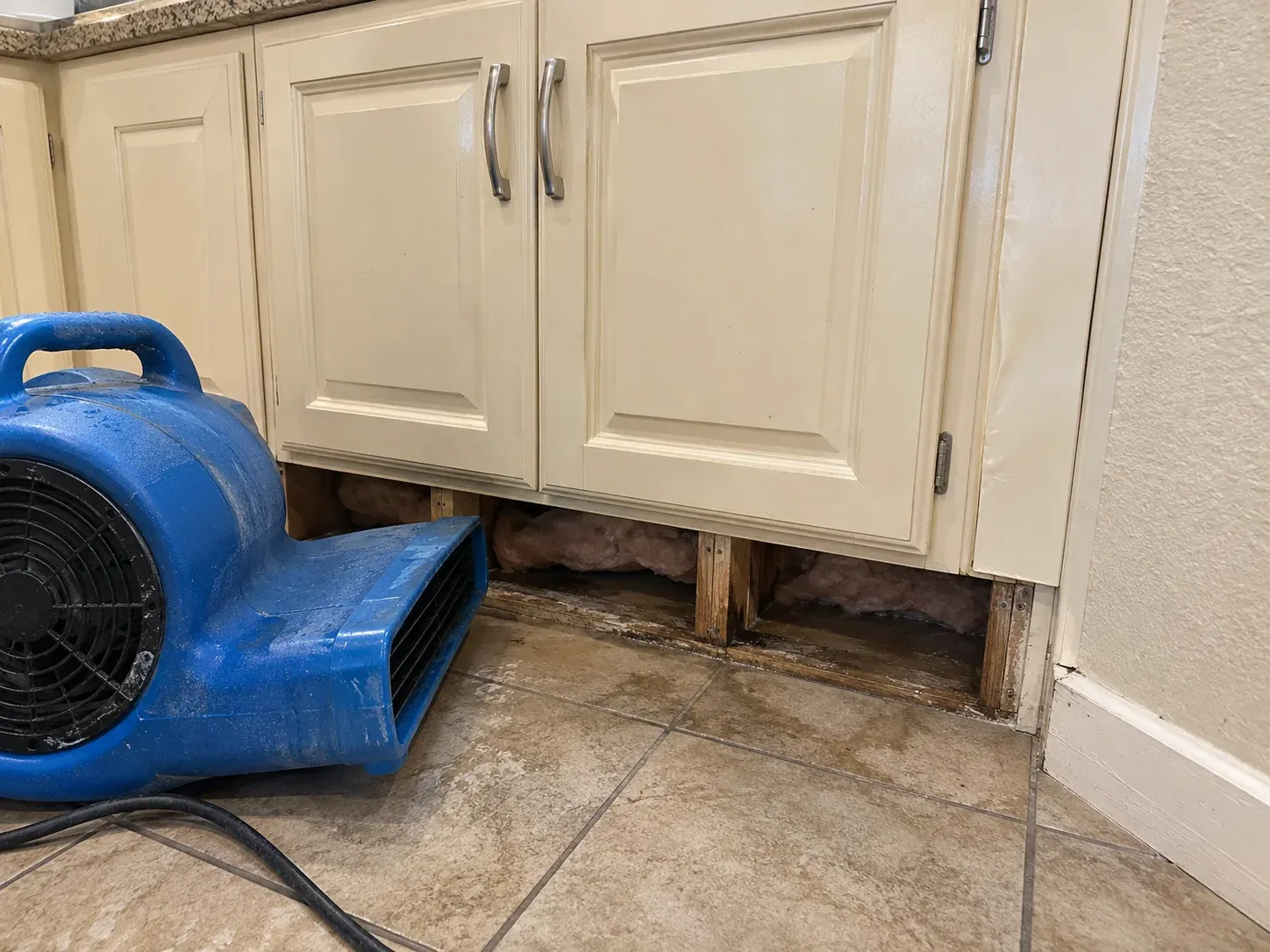
A room can look dry an hour after extraction and still be wet where it matters. Water sits in the carpet backing, in the pad, under the tile, inside the wall cavity below the water line, and in the wood of the cabinet toe kick. Extraction removes what is standing and what the wand can reach. Drying removes the rest, and it is measured, not guessed.
That is why an extraction visit should end with a moisture reading, at least at the perimeter of the wet area, and a plan for what comes next. If the reading is dry everywhere, you are done. If it is not, the drying equipment goes in right away, because every day between extraction and drying is a day the material stays wet.
10Good to know
Water extraction around Tempe
Tempe is a small city with a lot of different housing. The job changes block by block.
- Apartments and condos near ASU: Stacked units mean a leak on the third floor is a water damage job on the second and first. Have the HOA or property manager contact ready.
- 1950s and 1960s ranch houses: Original cast iron and galvanized lines, small bathrooms, carpet over slab. Water finds the lowest point and stays under the flooring.
- South Tempe and Warner Ranch: Larger footprints, tile throughout, AC units in the attic or on the roof deck. Condensate failures show up in ceilings.
- Downtown and Mill Avenue: Older commercial buildings with residential above. Work often has to happen after hours, in coordination with the business below.
- Mesa: 85201 to 85215
- Chandler: 85224, 85225, 85226, 85248, 85249, 85286
- Gilbert: 85233, 85234, 85295, 85296, 85297, 85298
- Ahwatukee: 85044, 85045, 85048
- Guadalupe: 85283
- Phoenix: Central and South Phoenix
114 questions
Questions people ask about water extraction in Tempe
Still have a question?
Send the form and describe what you see. Someone from our team will call you back soon.
Get a call back01What happens when I call at night?
Calls are answered day and night. Say where the water is coming from, which rooms are wet, and whether it is still running. If all lines are busy, leave a message or send the form on the contact page, and someone from our team will call you back soon.
02Can a wet carpet be extracted and saved?
Sometimes. Category 1 water, caught within 24 to 48 hours, with a carpet that can be lifted and dried with air moving under it, often comes back. Sewage, long soak times, or a delaminated backing means replacement.
03Do I need to empty the room first?
No. Furniture gets moved as part of the work. What helps is having small valuables, medication, electronics and documents out of the way beforehand.
04What about the water under the tile?
That is often the part a homeowner cannot see. Grout is permeable, so water gets under the field tile and sits on the slab. It shows up as a dark grout line, a loose tile, or a reading on a meter. It usually dries with air movement and dehumidification, sometimes with the baseboard pulled.